First, Let's Clarify What SSL Certificates Actually Do
Before diving into DV/OV/EV, let's quickly run through the basics of SSL certificates.
An SSL certificate (technically called a TLS certificate today, though "SSL" stuck) serves two core purposes:
1. Encrypting communication: It turns the data traveling between your browser and the server into ciphertext — unreadable and untamperable by anyone in the middle.
2. Proving identity: It tells users "this website really is who it claims to be," rather than a phishing site pretending to be it.
Every SSL certificate handles the first job.
The second job is where DV, OV, and EV diverge — their core difference lies in how rigorously identity is verified.
DV Certificate: Proves You Own the Domain
DV = Domain Validation.
The CA (Certificate Authority) verifies exactly one thing: whether you control the domain.
How? Typically one of the following:
- Adding a specific TXT or CNAME record to your DNS
- Placing a specific verification file in your website's root directory
- Clicking a confirmation link sent to
[email protected]
The process is largely automated — done in minutes, or at most a few hours. The CA doesn't care who you are, what your company is called, or whether you have a business license. All that matters is proving you control the domain.
What a DV Certificate Looks Like
In the browser address bar, a site with a DV certificate shows a small padlock icon (exact appearance varies by browser version). Clicking it shows the certificate details — but you'll only see the domain name. No organization or company name is listed.
The Limitation of DV
A DV certificate cannot prove which company owns the site — only that someone controls the domain. A bad actor could register ba1du.com (with the number 1, not the letter i), get a DV certificate, and the browser will still show a padlock and HTTPS. That doesn't stop it from being a phishing site.
So remember: a padlock ≠ trustworthy site. It only means the connection is encrypted.
OV Certificate: Verifies Your Organization Actually Exists
OV = Organization Validation.
Before issuing an OV certificate, the CA verifies domain control and also checks your organization:
- Whether the business or organization genuinely exists (typically via business registration records)
- Whether the organization name matches what was submitted
- Usually includes a phone verification as well
This process requires human review and typically takes 1–3 business days.
What an OV Certificate Looks Like
The padlock in the browser address bar looks identical to a DV certificate — ordinary users can't tell the difference at a glance. But inside the certificate details, the Subject field includes the organization name (O field), such as O = Example Inc.
Wait — if it looks the same to users, how can they tell?
Honestly… most users can't, which is one reason OV gets criticized as "not worth it" by some. OV's value is more about a company's internal compliance requirements and is mainly meaningful to technical staff or auditors.
EV Certificate: The Strictest Verification (and That Historic Green Bar)
EV = Extended Validation.
EV is the most rigorous of the three. The CA conducts a thorough background check:
- Verifying the company's legal entity information
- Confirming the organization's operating address
- Confirming the applicant is authorized to act on behalf of the organization
- Cross-checking various official databases
The entire process can take days to weeks, and it's the most expensive option.
A Bit of History: The Green Address Bar That Disappeared
If you were around the internet circa 2015, you might remember how some bank and payment websites had a green address bar that displayed the company name — something like PayPal, Inc. [US] right there in plain sight. Very noticeable.
That was EV certificates' signature visual treatment.
Between 2018 and 2019, however, Safari, Chrome, and Firefox all dropped the green EV address bar. The reason was straightforward: research showed users simply didn't notice it, and it offered almost no real benefit against phishing.
Today, EV certificates look the same as OV in the browser — just a padlock. You need to open the certificate details to see the fuller organization information.
Is EV Still Worth Buying?
This is an ongoing debate in the security community. My take:
- If your business has specific regulatory compliance requirements that explicitly call for EV (as some financial industry regulations do), then yes, get it.
- If you just want to "appear more secure" or "build user trust," that argument has been pretty weak ever since the green bar went away.
Side Note: IP Certificates
Now that we've covered DV/OV/EV, let's quickly touch on another type of certificate that doesn't come up as often — the IP certificate.
What Is an IP Certificate?
Regular SSL certificates are issued to domain names, like example.com. But sometimes a service has no domain name — only a public IP address, like https://1.2.3.4. If you want HTTPS in that case, you need an IP certificate (also called an IP SAN certificate).
When Would You Need One?
- Services with no domain name, reachable only via a public IP
- IoT devices or device management dashboards exposed directly on a public IP
- Certain B2B integrations that communicate directly via IP
Note that public CAs only issue certificates for public IP addresses. Private IPs (like 192.168.x.x) can't get a publicly trusted certificate — use a self-signed cert or an internal CA instead.
IP certificates used to be sold mainly by commercial CAs. Since January 2026, Let's Encrypt issues them for free too, but they're only valid for about six days, so renewal has to be fully automated.
Comparison: DV, OV, EV, and IP Certificates
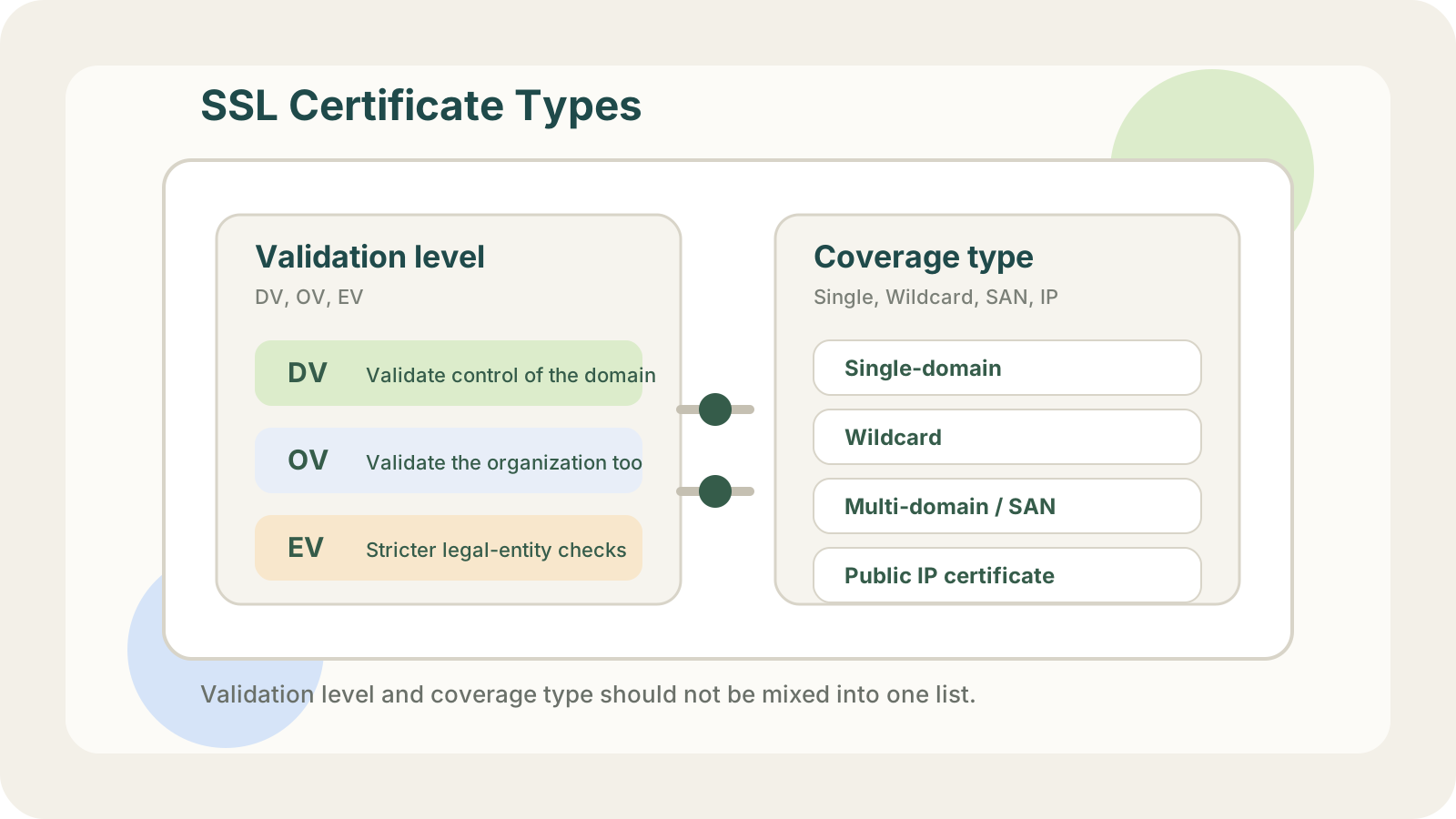
Strictly speaking, IP certificates sit on a different axis: DV/OV/EV describe the validation level, while an IP certificate describes what it's issued to — and IP certificates themselves come in DV and OV flavors. They're side by side here just for easy reference.
| DV | OV | EV | IP Certificate | |
|---|---|---|---|---|
| Full name | Domain Validation | Organization Validation | Extended Validation | IP Address Certificate |
| Issued to | Domain name | Domain name | Domain name | Public IP address |
| What's verified | Domain control | Domain + organization legitimacy | Domain + org + strict legal review | IP control (OV versions also verify the organization) |
| Issuance speed | Minutes to hours | 1–3 business days | Days to weeks | DV: minutes; OV: 1–3 business days |
| Cost | Free or very cheap | Moderate | Expensive | Free from Let's Encrypt (~6-day validity); moderate from commercial CAs |
Common Misconceptions
Misconception 1: "Free certificates are less secure"
Wrong. Free DV certificates use the same encryption strength as paid ones, and many major companies rely on them. The difference between free and paid is validation level and commercial support, not encryption strength.
Misconception 2: "An EV certificate makes my website more secure"
Not quite. EV improves identity trustworthiness, not server security. If your server code has vulnerabilities, no certificate can fix that.
Misconception 3: "The HTTPS padlock means a site is trustworthy"
This is the most dangerous misconception. The padlock only means the connection is encrypted — not that the site's content or operators are trustworthy. Phishing sites can have HTTPS too.
So Which Should You Choose?
Here's a simple decision tree:
Your service has no domain name — only an IP address?
  → You need an IP certificate (public IPs only)
  → For private IPs (192.168.x.x / 10.x.x.x), consider a self-signed cert or internal CA

If you have a domain, keep reading:

  Personal project or small team, not handling finance/medical/sensitive data?
    → DV is fine. Use Let's Encrypt for free.

  Customers, partners, or procurement require your company name in the cert?
    → Go with OV.

  Explicit compliance requirement calling for EV (it's in your regulatory docs)?
    → Then go with EV.

  Still not sure? Honestly, DV is probably enough — same encryption strength,
  free, and easy to manage.
In short, DV, OV, and EV differ in how strictly identity is verified; the encryption is the same. Which one you need depends on your business requirements and compliance obligations.
If you're still deciding whether a certificate is worth paying for, see our post on Free vs. Paid SSL Certificates, which covers how they differ in validation, trust, and support.
If you settle on a free DV certificate, LapseZero can automate issuance, renewal, and deployment, and alert you before a certificate expires.