When people first run into SSL certificates, they often ask the same question: if a free certificate already gives a site HTTPS and the browser shows a secure connection, why do paid certificates exist — some costing hundreds or even thousands of dollars? Is there a real security difference, or is it just brand markup?
The short answer: for encrypting traffic, free and paid certificates work about the same. Whether data is encrypted, and how strongly, depends on the TLS version, cipher suites, server configuration, and whether the certificate is trusted by mainstream browsers and operating systems. What you paid for the certificate has little to do with it.
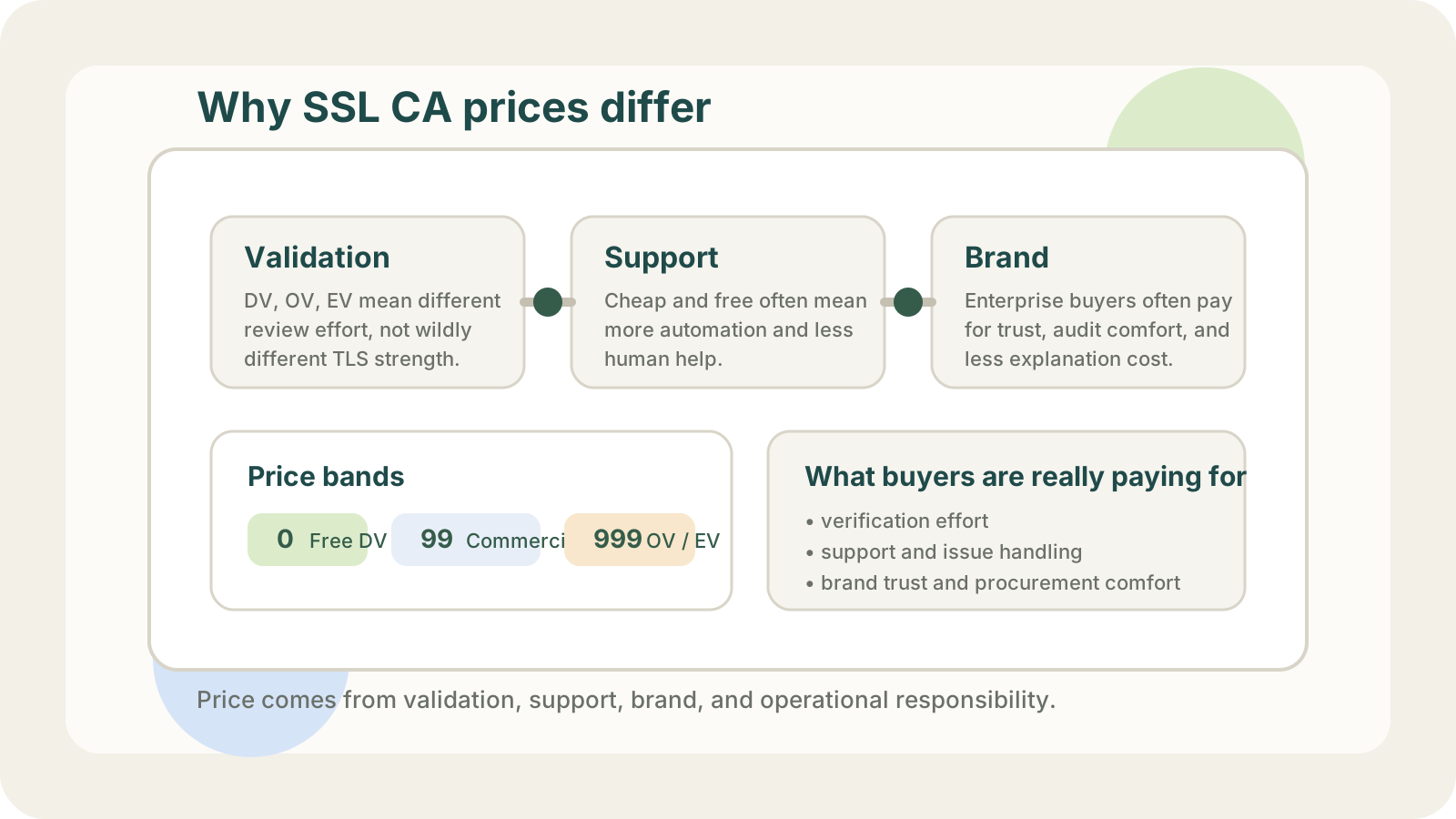
The real differences come down to four things.
1. Validation Level
The most common free SSL certificates are DV (Domain Validation) certificates. They verify one thing: whether you control the domain. If you can add a specific DNS record or place a specific file in your web directory, the certificate authority can confirm control and issue the certificate.
A DV certificate doesn't check which company is behind the domain, whether that company actually exists, whether its business address is accurate, or whether the brand entity matches.
Paid certificates commonly include OV and EV options, which add organization identity checks. OV verifies the business or organization; EV is stricter, typically also checking company registration records, the operating entity, and who is authorized to act for it.
In other words, DV proves "you control this domain," while OV/EV also proves "the organization behind this domain has been verified." That's the first source of the price gap: paid certificates sell a more complete identity verification process on top of encryption.
2. Trust Endorsement
EV certificates used to have a very visible selling point: browsers showed the company name in the address bar, sometimes on a green background. Mainstream browsers have since removed that treatment. Most users just see HTTPS and the browser's security indicator, and very few ever distinguish between DV, OV, and EV.
That's why a free DV certificate is usually enough for personal sites, blogs, typical SaaS dashboards, and API services.
OV/EV still matters in a different set of situations: finance, e-commerce, payments, government or enterprise partnerships, procurement bids, and brands that are frequent impersonation targets. In these cases customers, partners, or compliance teams may explicitly require an organization-validated certificate. What the paid certificate solves here is trust and compliance — the encryption is no stronger.
3. Service and Support
Free certificates rely on automation tools and community ecosystems. They're free, open, and fast to issue, which makes them a great fit for teams that automate deployment.
Paid certificates usually come with commercial services: human support, enterprise accounts, bulk management, invoices and contracts, refund policies, site seals, and warranty terms. Individual developers rarely need these, but for some organizations they are part of procurement and risk management — a company may require vendors to provide contracts and invoices, a client may require an organization-validated certificate, or an operations team may want a clear support channel when something breaks.
So part of a paid certificate's price pays for commercial service, procurement support, and accountability. Whether that's worth it depends on your situation.
4. Coverage Scope
Price also depends on what the certificate covers. There are three common types:
- Single-domain certificates protect one specific name, such as
www.example.com. - Wildcard certificates protect every subdomain at one level, such as
*.example.com. - Multi-domain (SAN) certificates include several different domains in one certificate.
On the paid market, wildcard and multi-domain certificates usually cost considerably more than single-domain ones, and the price climbs with the number of names.
But covering many domains or subdomains doesn't have to be expensive. Free CAs like Let's Encrypt also issue wildcard and multi-domain certificates, and with DNS validation and ACME-based automation, certificate costs can stay very low.
Conclusion
The difference between free and paid certificates is not "secure" versus "insecure." Free certificates lowered the barrier to HTTPS; paid certificates add value mainly through identity verification, commercial support, and procurement compliance.
A Certificate Doesn't End When It's Issued
In real operations, the part that gets overlooked is what happens after issuance. When does the certificate expire? Did renewal succeed? If it failed, did anyone get alerted? Did the new certificate reach the right servers? Many HTTPS incidents come from these steps, not from the certificate itself.
Certificate lifetimes are also getting shorter. Since March 2026, the maximum lifetime for public certificates has dropped from 398 to 200 days, and it will reach 47 days in 2029. Shorter lifetimes shrink the risk window from key compromise or mis-issuance, which is good for security. For operations, though, it means more frequent renewals and more chances for manual processes to slip.
With one or two domains, handling renewals by hand is still manageable. With dozens of domains, several environments and servers, and multiple cloud providers and CDNs, relying on spreadsheets, calendar reminders, and manual console logins will eventually go wrong.
So the question worth asking today goes beyond "free or paid": Is renewal automated? Is deployment automated? Will monitoring and alerts catch problems before users do?
That's why we built LapseZero. For many small teams, independent developers, and solo product builders, the practical needs are simple: get free certificates, including wildcards; get a heads-up before a certificate expires; stop relying on memory for renewal and deployment. Today, LapseZero can:
- issue free single-domain and wildcard certificates, validated through DNS-01;
- renew certificates automatically as they approach expiry and deploy them to the servers and cloud products you configure;
- monitor certificates on your existing sites for free and alert you when they are nearing expiry, already expired, or failing checks.
The certificate itself may be free, but the outage from an expired one isn't: failed page loads, broken API calls, missed payment callbacks, or an emergency at 2 a.m. Moving certificates from "someone remembers" to "the system keeps track" is what LapseZero sets out to do first.